About Vedanta Centre
THE VEDANTA CENTRE
of Boston was founded in 1909 by Swami Vivekananda's youngest disciple,
Swami Paramananda. Another ashrama was established on the South
Shore of Massachusetts in Cohasset in 1929. This ashrama is now
the permanent headquarters of the Vedanta Centre, and is the sister
ashrama to Ananda Ashrama of La Crescenta, California.
The ashrama is a non-sectarian place of worship dedicated to all
the religions of the world, where people of different faiths may
come together and worship the One Spirit Who is called by many names.
Our philosophy is based on the universal teachings of Vedanta as
expounded by India's 19th century mystic and world teacher, Sri
Ramakrishna. His chief disciple Swami Vivekananda brought Vedanta
to the West in 1893.
Ananda is the Sanskrit word for bliss. An ashrama is a spiritual
retreat. Ananda Ashrama, therefore, is a retreat where one strives
to live by and practice spiritual life in order to realize the joy
of the Divine.
THE TEMPLE OF THE UNIVERSAL
SPIRIT (VISHWAMANDIR)
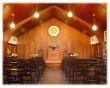
The Vedanta Centre Temple of the Universal Spirit
is dedicated to all of the world's great religions. Each is represented
by stained glass symbols in each window, statues and scriptural
quotations. Our Cohasset Temple was dedicated in 1959 on the 50th
anniversary. It was designed by Srimata Gayatri Devi. The California
Temple at Ananda Ashrama was built in 1928 under the direction of
our founder, Swami Paramananda.
PURPOSE
The purpose of the centers in the United States is to present authentic
knowledge of Indian philosophy, as well as to stimulate better understanding
between the East and West on a spiritual basis.
Through our services and classes, we emphasize
practice of the universal truths taught in all great religions:
love and service together with study, prayer and meditation. Our
primary aim is to stress the life of selfless dedication and to
create an atmosphere of serenity and peace.
We also have two sister ashramas in Kolkata, India, the Sree Ramakrishna Ananda Ashramas.
The mission of these ashramas is to train and serve destitute women
and children through schools, an orphanage, and a shelter.
|
 |
 |
|
 |
| |
"Hold aloft the light
and stand firm to thy post
Till all wandering souls have
reached their goal in safety.
Service brings strength
and renewed life,
Love cures all weariness,
And Faith, the shining jewel
of life,
performs all miracles. "
~ Swami Paramananda |
|
 |
|
 |
|